Product Database
Loongson XA612A0_v1.0

INFO
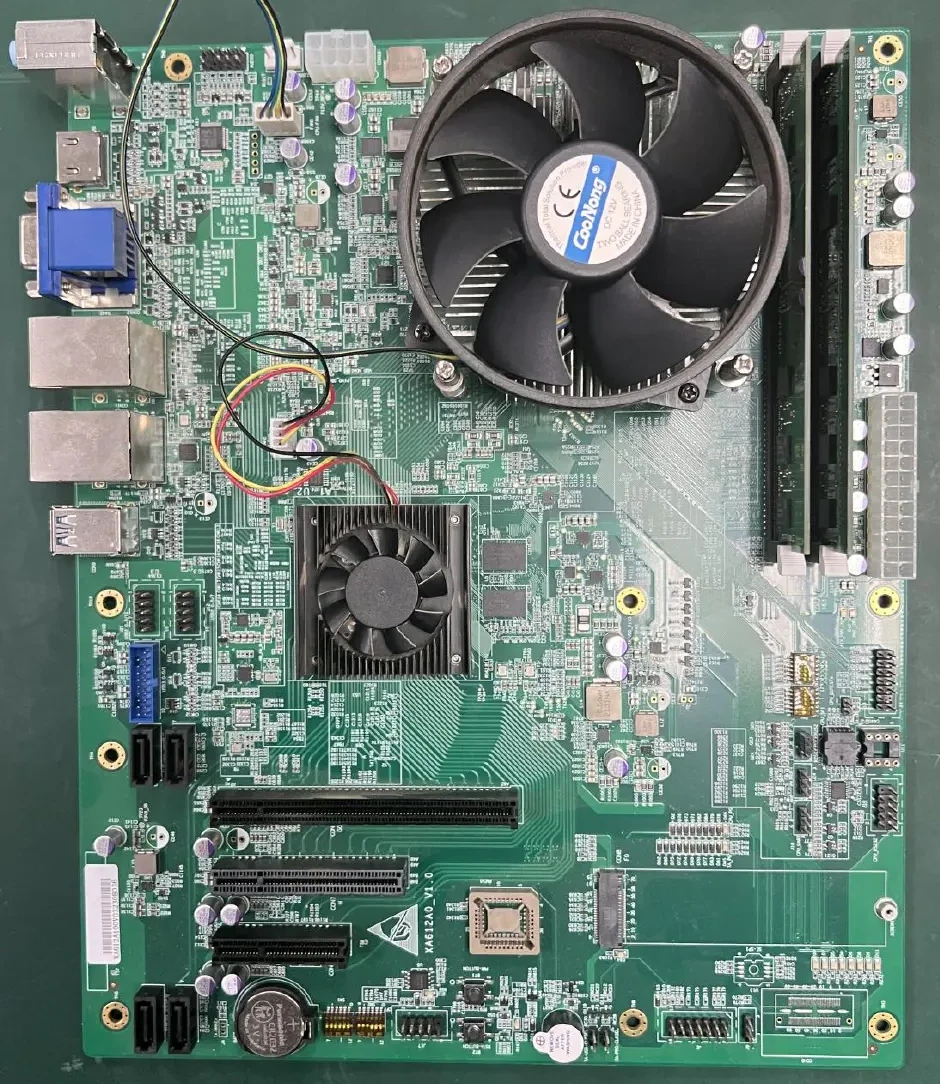
The Loongson XA612A0_v1.0 is an ATX (244×305mm) desktop motherboard based on Loongson 3A6000-HV.
This motherboard is the first 3A6000 motherboard released by Loongson and is generally considered an evaluation board (EVB).
| Category | Specification |
|---|---|
| Manufacturer | Loongson Technology |
| Form Factor | ATX (244×305mm) |
| Processor | 3A6000-HV @ 2.5GHz |
| Memory | DDR4 @ 3200MT/s (2 × DIMM), supports ECC† |
| Interfaces (PCIe) | 2 × PCIe 3.0 x16 (x8 lanes), 1 × PCIe 3.0 x4 (x4 lanes) |
| Interfaces (USB) | USB 3.0 (2 × onboard, 2 × front panel), USB 2.0 (2 × onboard, 4 × front panel) |
| Interfaces (Storage) | 1 × NVMe (PCIe 3.0 x4), 4 × SATA 3.0 |
| Interfaces (Network) | 1 × GbE |
| Interfaces (Video) | 1 × HDMI, 1 × VGA |
| Interfaces (Other) | 1 set of 3.5mm (input, output, Line-In) interfaces, 1 × RS-232 serial port (DB-9) |
†: The state of ECC memory support of this motherboard is currently unclear. It is also not clear whether it supports Registered ECC memory. DMI information also does not declare 72-bit wide memory interface.
7A Bridge Instability
Motherboards that uses the 7A2000 bridge chip to provide PCIe interface are known to be unstable with certain peripherals (especially AMD graphics cards based on the GCN 1.0 - 4.0 architectures). Users of these graphics cards may see driver instabilities, graphical glitches, application crashes, or even lock ups. The cause behind this issue is yet to be confirmed.
At present, some Linux distros includes workarounds for this issue, which improves the situation significantly, but we still see occasional user complaints.
If you have ran into situations like this, improving cooling on the bridge chip is also known to lessen the symptom.
If you experience similar issues, the community recommends improving the case or bridge chip cooling.
This version contains primarily updates to key hardware support components, such as PHY, MRC, SMC, PCIe, and IPMI, etc. Also updated are SPI/Variable, ACPI/SMBIOS, Boot Manager, User Interface, and Platform support components.
Loongson UEFI Firmware Binaries for the Community (V5.0.0639-stable202608)
1. Overview
This version contains primarily updates to key hardware support components, such as PHY, MRC, SMC, PCIe, and IPMI, etc. Also updated are SPI/Variable, ACPI/SMBIOS, Boot Manager, User Interface, and Platform support components.
Speaking from a high-level perspective, the 202608 release improves stability for multi-node/multi-processor systems, device identification and initialization, boot performance, and peripheral compatibility:
- Core component updates: Updated key components, improving support for Loongson 2K3000/3B6000M, 3A5000, 3A6000, 3B6000, 3C6000/S/D/Q, and 7A2000-based platforms.
- Platform support improvements: Added support for TD612D0 (single-processor Loongson 3C6000/D workstation motherboard).
- Functionality enhancements: Introduced support for eMMC device information querying, default password, PCIe device serial detection, and Secure Engine-based hardware random number generator, as well as automatic to ESP boot entry naming, and improvements to the display initialisation interface.
- Stability and compatibility: Resolved a series of issues found in EFI variable handling, SPI flash, PXE, GRUB exits, Secure Boot configuration, ACPI, SMBIOS, display, newtorking, and storage, as well as stability and startup speed optimisation for multi-node/processor systems and systems with complex PCIe topology.
2. Key Component Updates
Please note that detailed changes and versions for some key components are not listed for public changelos.
| Component | Version Update | Changes |
|---|---|---|
| Loongson-FwSdk | Updated to V5.0.0639-stable202608 | Includes updates and improvements for platforms and devices based on Loongson 2K3000/3B6000M/3A6000/3B6000/3C6000/S/D/Q and 7A2000 |
| IPMI Support Module | - | Fixed several interface issues, such as configuration errors, user password lengths, SMBIOS/FRU update on the BMC end, and issues with AC power cycle stability |
| Filesystem and Emulator Modules | - | Updated the Ext2 filesystem driver, with workaround for data read issues with certain closed-source RAID drivers |
| EDK II (public code) | stable202602 | Enhanced usage for upstream implementation in modules such as HiiDatabaseDxe, VariableRuntimeDxe, and VariablePolicyProtocol, etc., reducing code redundancy and improving consistency with upstream interfaces |
3. Support for Chips and Platforms
3.1 2K3000/3B6000M-based Platforms
- Added the ability to replace EDID for 2K3000/3B6000M-based laptops, allowing different eDP screen configurations based on product designs.
- Added the ability to keep the DC (Display Controller) working as a display output when GPU is disabled.
- Improved ACPI events, GPIO, and memory reset handling.
- Improved DisplayPort AUX packet processing, fixing compatibility with some eDP adapters/convertors.
- Updated the VBIOS display configuration for the X2K30B0 motherboard, ensuring functionality for single-channel DP/HDMI interfaces.
- Enabled description for LPC nodes in the ACPI.DSDT table.
- Fixed SMC chip type identification.
- Fixed intermitten EDID read failure over DisplayPort.
- Fixed incorrect I²C bus frequency calculation.
- Fixed voltage regulation logic on reboots, eliminating unexpected voltage regulation.
3.2 3A6000-based Platforms
- Refactored I²C voltage regulation, improving maintainability and log output.
- Optimized SMC data access policy in several scenarios, ensuring both stability and efficient execution.
- Optimized platform-specific voltage configuration defaults and logging for unexpected inputs.
- Optimized several atomic operations.
- Fixed SPI dual-wire mode configuration and incomplete register recovery on parameter fallback.
3.3 3B6000- and 3C6000-based Platforms
- Enabled HPTW (Hardware PageTable Walk) - please note that this feature is suggested for use with Loongnix Server 23.3 (Linux 6.6.52-1.12) or mainline kernels of version 7.1.5 or higher.
- Added support for the TD612D0 motherboard, adapting it to latest SMC and build system enhancements.
- Added detection and identification support for lower-frequency 3B6000 and 3C6000 SKUs.
- Optimized slave node reset and cross-node access stability during reboot on multi-node/processor 3C6000 systems.
- Optimized link initialization stability during power on.
- Optimized memory parameters for 3C6000/D, lowering likelihood for ECC errors.
- Optimized several atomic operations.
- Improved ACPI SRAT handling (except for dual 3C6000/S), making sure that processor descriptors were generated from real core indices.
- Optimized PCIe parameter saving and link configuration when training is disabled, eliminating unwanted interference from inappropriate parameters.
- Fixed incorrect memory temperature and CPU count display on the BMC's Web interface on multi-node 3C6000/S and 3C6000/D servers.
- Fixed incorrect maximum-frequency display after enabling DVFS on 3B6000-based systems.
3.4 7A2000 Bridge Chip
- Improved GPIO handling interface, adding configurability to multi-bitwidth access, input state, and interrupt polarity features.
- Optimized AHCI sequential write performance when using the bridge chip with a PCIe uplink.
- Fixed PCIe port initialization control, where GEN1 speed configuration could fail to apply.
3.5 Motherboards and Peripherals
- [IMPORTANT] Fixed a severe issue where the I²C voltage regulation channel would set an exceedingly high core voltage on the XA612A0 motherboard, users currently running the stable202602/05 firmware are strongly recommended to update.
- Added eMMC information querying, display in the firmware setup interface, and a dedicated boot-entry type; also improved eMMC boot-entry naming and handling when no eMMC device is present.
- Improved filesystem driver for Ext2, fixing path access issue on controller removal.
- Optimized network interface initialization, PXE toggle, and network protocol exit routines.
- Optimized device detection, disabling, and enabling for some PCIe devices, NVMe controller, and complex PCIe topologies..
- Fixed non-stopping beep during boot-up on the QC622D1 (dual 3C6000/S) motherboard.
4. General Enhancements and Optimizations
4.1 New Features
- Improved naming logic for ESP boot entries, introducing the ability to identify operating systems by known bootloader paths, supporting Loongnix, UOS, Kylin, openEuler, deepin, Anolis, Arch Linux, AOSC OS, and other operating systems and Linux distros.
- Added or improved ACPI ThermalZone
_STRdescriptors, adding support for nodes on 3A6000/7A2000. - Added processor thread count display in the system information page.
- Added configurable default administrator password (defaults to empty or no password).
- Added EDAC memory controller indices and per-node controller count properties in the ACPI table, making it easier for Linux kernel driver to detect the relationship between the controller and processor node(s).
- Added LoongArch PE/COFF image parser to the Secure Boot configuration module.
- Added the ability to read PCIe device serial number(s), which could be used to improve the level of details in SMBIOS information.
- Added VID/DID debug information during PCI initialization, easing debugging and troubleshooting.
- Added optional platform-specific policy to continue searching for PCI Function 1-7 when Function 0 does not exist.
- Added BaseRngLib implementation based on the Loongson Secure Engine - when the Secure Engine is not available, a CPU-based fallback is available.
- Added available Proximity Domain and NUMA topology description to the ACPI IOVT table, enhancing SR-IOV scheduling performance.
- Enabled Reset Notification Protocol support in the ResetRuntimeDxe module, allowing NVMe and other controllers to perform necessary shutdown procedures during system reboot/reset.
- Added support for Serial Flash Discoverable Parameters (SFDP) parsing and page-based write optimization, improving UEFI firmware update speeds (a fallback path is reserved for devices that do not support SFDP).
4.2 Improvements and Adjustments
- Optimized ACPI PCI I/O resource descriptors for multi-node/processor platforms, allowing each node to allocate an appropriate amount of I/O space.
- Improved status initialization for Secure Engine in device mode.
- Refactored EFI variable read/write and management mode implementation, making use of upstream VariableRuntimeDxe, FaultTolerantWriteDxe, and VariablePolicyProtocol module implementation from the upstream, improving variable area and fault tolerance write area management.
- Disabled NVMe OptionRom loading, preventing conflict between x86 emulation and native drivers.
- Optimized boot-up timeout handling when reverting to default configurations - the firmware will now use the platform default timeout.
- Optimized LoongArch64 firmware segment alignment, allowing PE/COFF images to fit page alignment requirements.
- Optimized boot-up progress display for Denglin's AI accelerator card, reducing screen refreshed and lowering start-up times on systems with complex PCIe topologies.
- Optimized help information for administrator password, making it consistent with the actual length limit and adding notification when the password exceeds that length.
- Removed the no-longer-supported virtual/physical address switching mode from the Legacy Boot option, the legacy BPI interface specification is no longer supported.
- Updated PCI ID database to 2026-08-11 and added information for several non-upstream device IDs.
5. General Bugfixes
5.1 Bugfixes
- Fixed an issue where the SMC configuration could not be changed in Release firmware.
- Fixed an issue where randomly generated MAC addresses were overwritten during reboots by making the randomly generated addresses non-volatile.
- Fixed an issue where the PXE/HTTP options were disabled (greyed-out) after pressing the F9/F10 hotkeys.
- Fixed an issue where the PXE switch no longer works after the option was enabled.
- Fixed an issue that prevented the PXE driver from initializing.
- Fixed an issue where the boot paths stopped working after the UEFI Shell was moved to another Firmware Volume.
- Fixed an issue where the system may hang after executing
exitfrom the GRUB command line. - Fixed residual displays after toggling between Chinese and English interfaces, also improved Chinese translation.
- Fixed an issue where the system time could not be saved after loading factory CMOS defaults when the administrator password is enabled.
- Fixed incorrect memory device count in SMBIOS information, as well as issues with missing NVMe device information and registration sequences.
- Fixed an issue where the BMC user password length limit was inconsistent with that specified in the help information.
- Fixed various issues with SMC parameter table length checks, frequency calibration, power consumption limits, temperature displays, and BMC function toggles.
- Fixed IPMI BMC display configuration access could cause assertion errors during boot-up, resulting in boot failures.
- Fixed an issue where invalid configuration dependencies in the Secure Engine's "empty" implementation could cause assertion errors during boot-up, resulting in boot failures.
- Fixed SPI flash parameter parsing errors, causing potential heap memory and UEFI variable storage corruption.
- Fixed incorrect usage of
Exclusive/SharedACPI interrupt resources properties. - Fixed display offsets in graphical output.
- Fixed warning caused by recursive use of looped delays in network interface delay logic.
- Fixed consecutive errors when calling the UNDI interface on some network interface controllers.
- Fixed an issue where the save confirmation result passing did not match EDK II's interface.
- Fixed freeing of uninitialized pointers and memory leak in the callback path in the Secure Boot configuration module.
- Fixed multiple memory leaks and invalid dependencies in driver and platform libraries.
5.3 Update Statistics
| Area | № of Issues Fixed | № of New Features and Functionalities | № of Optimizations and Adjustments | Subtotals |
|---|---|---|---|---|
| 2K3000 / 3B6000M | 4 | 3 | 3 | 10 |
| 3A6000 | 2 | 0 | 4 | 6 |
| 3B6000 / 3C6000/S/D/Q | 2 | 3 | 6 | 11 |
| 7A2000 | 1 | 1 | 1 | 3 |
| Motherboards & Peripherals | 1 | 1 | 2 | 4 |
| General Features | 22 | 12 | 11 | 45 |
| Totals | 32 | 20 | 27 | 79 |
6. Notes
- After setting a default administrator password and expiration date, should the device be shipped after that date, the user would see a notification regarding password expiration.
- The EDID replacement functionality for 2K3000/3B6000M requires that valid EDID data could be read from the target channel.
- PCI function scanning with missing Function 0 is an optional platform-specific policy.
- HPTW on 3B6000/3C6000 is only recommended with Loongnix Server 23.3 (Linux 6.6.52-1.12) or mainline kernels of version 7.1.5 or higher.
- PC platform runs a mandated memory resource detection routine after the first reboot following a firmare update - however, the routine may trigger a reboot, making it appear as though the system unexpectedly rebooted twice - we will attempt to find a solution to this issue before the next release.
- Firmware with support for mainline DVFS (Dynamic CPU/SoC Voltage Frequency Scaling) - this functionality is still considered community preview, firmware binaries with the
_mainline-dvfssuffix (e.g.,[...]_mainline-dvfs.fd) has this preview feature enabled - though please note that the BIOS setup does not show this version identifier.
7. References
- EDK II - A case of migration to VariablePolicyProtocol from VariableLockProtocol, https://github.com/tianocore/edk2/pull/1128
- EDK II - An example fix for boot-up failure when the Shell is located in a different Firmware Volume, https://github.com/tianocore/edk2/pull/4377
- EDK II - An example issue for NIC-related errors during ExitBootServices, https://github.com/tianocore/edk2/issues/8063
- EDK II - Discussion for scanning other PCI Functions when Function 0 is missing, https://github.com/tianocore/edk2/pull/12572
- EDK II - LoongArch PE/OFF parsing support for Secure Boot, https://github.com/tianocore/edk2/pull/12709
- PCI ID database, https://github.com/pciutils/pciids
This version contains primarily updates to key hardware support components, such as PHY, MRC, SMC, PCIe, and IPMI, etc. Also updated are SPI/Variable, ACPI/SMBIOS, Boot Manager, User Interface, and Platform support components.
Loongson UEFI Firmware Binaries for the Community (V5.0.0639-stable202608)
1. Overview
This version contains primarily updates to key hardware support components, such as PHY, MRC, SMC, PCIe, and IPMI, etc. Also updated are SPI/Variable, ACPI/SMBIOS, Boot Manager, User Interface, and Platform support components.
Speaking from a high-level perspective, the 202608 release improves stability for multi-node/multi-processor systems, device identification and initialization, boot performance, and peripheral compatibility:
- Core component updates: Updated key components, improving support for Loongson 2K3000/3B6000M, 3A5000, 3A6000, 3B6000, 3C6000/S/D/Q, and 7A2000-based platforms.
- Platform support improvements: Added support for TD612D0 (single-processor Loongson 3C6000/D workstation motherboard).
- Functionality enhancements: Introduced support for eMMC device information querying, default password, PCIe device serial detection, and Secure Engine-based hardware random number generator, as well as automatic to ESP boot entry naming, and improvements to the display initialisation interface.
- Stability and compatibility: Resolved a series of issues found in EFI variable handling, SPI flash, PXE, GRUB exits, Secure Boot configuration, ACPI, SMBIOS, display, newtorking, and storage, as well as stability and startup speed optimisation for multi-node/processor systems and systems with complex PCIe topology.
2. Key Component Updates
Please note that detailed changes and versions for some key components are not listed for public changelos.
| Component | Version Update | Changes |
|---|---|---|
| Loongson-FwSdk | Updated to V5.0.0639-stable202608 | Includes updates and improvements for platforms and devices based on Loongson 2K3000/3B6000M/3A6000/3B6000/3C6000/S/D/Q and 7A2000 |
| IPMI Support Module | - | Fixed several interface issues, such as configuration errors, user password lengths, SMBIOS/FRU update on the BMC end, and issues with AC power cycle stability |
| Filesystem and Emulator Modules | - | Updated the Ext2 filesystem driver, with workaround for data read issues with certain closed-source RAID drivers |
| EDK II (public code) | stable202602 | Enhanced usage for upstream implementation in modules such as HiiDatabaseDxe, VariableRuntimeDxe, and VariablePolicyProtocol, etc., reducing code redundancy and improving consistency with upstream interfaces |
3. Support for Chips and Platforms
3.1 2K3000/3B6000M-based Platforms
- Added the ability to replace EDID for 2K3000/3B6000M-based laptops, allowing different eDP screen configurations based on product designs.
- Added the ability to keep the DC (Display Controller) working as a display output when GPU is disabled.
- Improved ACPI events, GPIO, and memory reset handling.
- Improved DisplayPort AUX packet processing, fixing compatibility with some eDP adapters/convertors.
- Updated the VBIOS display configuration for the X2K30B0 motherboard, ensuring functionality for single-channel DP/HDMI interfaces.
- Enabled description for LPC nodes in the ACPI.DSDT table.
- Fixed SMC chip type identification.
- Fixed intermitten EDID read failure over DisplayPort.
- Fixed incorrect I²C bus frequency calculation.
- Fixed voltage regulation logic on reboots, eliminating unexpected voltage regulation.
3.2 3A6000-based Platforms
- Refactored I²C voltage regulation, improving maintainability and log output.
- Optimized SMC data access policy in several scenarios, ensuring both stability and efficient execution.
- Optimized platform-specific voltage configuration defaults and logging for unexpected inputs.
- Optimized several atomic operations.
- Fixed SPI dual-wire mode configuration and incomplete register recovery on parameter fallback.
3.3 3B6000- and 3C6000-based Platforms
- Enabled HPTW (Hardware PageTable Walk) - please note that this feature is suggested for use with Loongnix Server 23.3 (Linux 6.6.52-1.12) or mainline kernels of version 7.1.5 or higher.
- Added support for the TD612D0 motherboard, adapting it to latest SMC and build system enhancements.
- Added detection and identification support for lower-frequency 3B6000 and 3C6000 SKUs.
- Optimized slave node reset and cross-node access stability during reboot on multi-node/processor 3C6000 systems.
- Optimized link initialization stability during power on.
- Optimized memory parameters for 3C6000/D, lowering likelihood for ECC errors.
- Optimized several atomic operations.
- Improved ACPI SRAT handling (except for dual 3C6000/S), making sure that processor descriptors were generated from real core indices.
- Optimized PCIe parameter saving and link configuration when training is disabled, eliminating unwanted interference from inappropriate parameters.
- Fixed incorrect memory temperature and CPU count display on the BMC's Web interface on multi-node 3C6000/S and 3C6000/D servers.
- Fixed incorrect maximum-frequency display after enabling DVFS on 3B6000-based systems.
3.4 7A2000 Bridge Chip
- Improved GPIO handling interface, adding configurability to multi-bitwidth access, input state, and interrupt polarity features.
- Optimized AHCI sequential write performance when using the bridge chip with a PCIe uplink.
- Fixed PCIe port initialization control, where GEN1 speed configuration could fail to apply.
3.5 Motherboards and Peripherals
- [IMPORTANT] Fixed a severe issue where the I²C voltage regulation channel would set an exceedingly high core voltage on the XA612A0 motherboard, users currently running the stable202602/05 firmware are strongly recommended to update.
- Added eMMC information querying, display in the firmware setup interface, and a dedicated boot-entry type; also improved eMMC boot-entry naming and handling when no eMMC device is present.
- Improved filesystem driver for Ext2, fixing path access issue on controller removal.
- Optimized network interface initialization, PXE toggle, and network protocol exit routines.
- Optimized device detection, disabling, and enabling for some PCIe devices, NVMe controller, and complex PCIe topologies..
- Fixed non-stopping beep during boot-up on the QC622D1 (dual 3C6000/S) motherboard.
4. General Enhancements and Optimizations
4.1 New Features
- Improved naming logic for ESP boot entries, introducing the ability to identify operating systems by known bootloader paths, supporting Loongnix, UOS, Kylin, openEuler, deepin, Anolis, Arch Linux, AOSC OS, and other operating systems and Linux distros.
- Added or improved ACPI ThermalZone
_STRdescriptors, adding support for nodes on 3A6000/7A2000. - Added processor thread count display in the system information page.
- Added configurable default administrator password (defaults to empty or no password).
- Added EDAC memory controller indices and per-node controller count properties in the ACPI table, making it easier for Linux kernel driver to detect the relationship between the controller and processor node(s).
- Added LoongArch PE/COFF image parser to the Secure Boot configuration module.
- Added the ability to read PCIe device serial number(s), which could be used to improve the level of details in SMBIOS information.
- Added VID/DID debug information during PCI initialization, easing debugging and troubleshooting.
- Added optional platform-specific policy to continue searching for PCI Function 1-7 when Function 0 does not exist.
- Added BaseRngLib implementation based on the Loongson Secure Engine - when the Secure Engine is not available, a CPU-based fallback is available.
- Added available Proximity Domain and NUMA topology description to the ACPI IOVT table, enhancing SR-IOV scheduling performance.
- Enabled Reset Notification Protocol support in the ResetRuntimeDxe module, allowing NVMe and other controllers to perform necessary shutdown procedures during system reboot/reset.
- Added support for Serial Flash Discoverable Parameters (SFDP) parsing and page-based write optimization, improving UEFI firmware update speeds (a fallback path is reserved for devices that do not support SFDP).
4.2 Improvements and Adjustments
- Optimized ACPI PCI I/O resource descriptors for multi-node/processor platforms, allowing each node to allocate an appropriate amount of I/O space.
- Improved status initialization for Secure Engine in device mode.
- Refactored EFI variable read/write and management mode implementation, making use of upstream VariableRuntimeDxe, FaultTolerantWriteDxe, and VariablePolicyProtocol module implementation from the upstream, improving variable area and fault tolerance write area management.
- Disabled NVMe OptionRom loading, preventing conflict between x86 emulation and native drivers.
- Optimized boot-up timeout handling when reverting to default configurations - the firmware will now use the platform default timeout.
- Optimized LoongArch64 firmware segment alignment, allowing PE/COFF images to fit page alignment requirements.
- Optimized boot-up progress display for Denglin's AI accelerator card, reducing screen refreshed and lowering start-up times on systems with complex PCIe topologies.
- Optimized help information for administrator password, making it consistent with the actual length limit and adding notification when the password exceeds that length.
- Removed the no-longer-supported virtual/physical address switching mode from the Legacy Boot option, the legacy BPI interface specification is no longer supported.
- Updated PCI ID database to 2026-08-11 and added information for several non-upstream device IDs.
5. General Bugfixes
5.1 Bugfixes
- Fixed an issue where the SMC configuration could not be changed in Release firmware.
- Fixed an issue where randomly generated MAC addresses were overwritten during reboots by making the randomly generated addresses non-volatile.
- Fixed an issue where the PXE/HTTP options were disabled (greyed-out) after pressing the F9/F10 hotkeys.
- Fixed an issue where the PXE switch no longer works after the option was enabled.
- Fixed an issue that prevented the PXE driver from initializing.
- Fixed an issue where the boot paths stopped working after the UEFI Shell was moved to another Firmware Volume.
- Fixed an issue where the system may hang after executing
exitfrom the GRUB command line. - Fixed residual displays after toggling between Chinese and English interfaces, also improved Chinese translation.
- Fixed an issue where the system time could not be saved after loading factory CMOS defaults when the administrator password is enabled.
- Fixed incorrect memory device count in SMBIOS information, as well as issues with missing NVMe device information and registration sequences.
- Fixed an issue where the BMC user password length limit was inconsistent with that specified in the help information.
- Fixed various issues with SMC parameter table length checks, frequency calibration, power consumption limits, temperature displays, and BMC function toggles.
- Fixed IPMI BMC display configuration access could cause assertion errors during boot-up, resulting in boot failures.
- Fixed an issue where invalid configuration dependencies in the Secure Engine's "empty" implementation could cause assertion errors during boot-up, resulting in boot failures.
- Fixed SPI flash parameter parsing errors, causing potential heap memory and UEFI variable storage corruption.
- Fixed incorrect usage of
Exclusive/SharedACPI interrupt resources properties. - Fixed display offsets in graphical output.
- Fixed warning caused by recursive use of looped delays in network interface delay logic.
- Fixed consecutive errors when calling the UNDI interface on some network interface controllers.
- Fixed an issue where the save confirmation result passing did not match EDK II's interface.
- Fixed freeing of uninitialized pointers and memory leak in the callback path in the Secure Boot configuration module.
- Fixed multiple memory leaks and invalid dependencies in driver and platform libraries.
5.3 Update Statistics
| Area | № of Issues Fixed | № of New Features and Functionalities | № of Optimizations and Adjustments | Subtotals |
|---|---|---|---|---|
| 2K3000 / 3B6000M | 4 | 3 | 3 | 10 |
| 3A6000 | 2 | 0 | 4 | 6 |
| 3B6000 / 3C6000/S/D/Q | 2 | 3 | 6 | 11 |
| 7A2000 | 1 | 1 | 1 | 3 |
| Motherboards & Peripherals | 1 | 1 | 2 | 4 |
| General Features | 22 | 12 | 11 | 45 |
| Totals | 32 | 20 | 27 | 79 |
6. Notes
- After setting a default administrator password and expiration date, should the device be shipped after that date, the user would see a notification regarding password expiration.
- The EDID replacement functionality for 2K3000/3B6000M requires that valid EDID data could be read from the target channel.
- PCI function scanning with missing Function 0 is an optional platform-specific policy.
- HPTW on 3B6000/3C6000 is only recommended with Loongnix Server 23.3 (Linux 6.6.52-1.12) or mainline kernels of version 7.1.5 or higher.
- PC platform runs a mandated memory resource detection routine after the first reboot following a firmare update - however, the routine may trigger a reboot, making it appear as though the system unexpectedly rebooted twice - we will attempt to find a solution to this issue before the next release.
- Firmware with support for mainline DVFS (Dynamic CPU/SoC Voltage Frequency Scaling) - this functionality is still considered community preview, firmware binaries with the
_mainline-dvfssuffix (e.g.,[...]_mainline-dvfs.fd) has this preview feature enabled - though please note that the BIOS setup does not show this version identifier.
7. References
- EDK II - A case of migration to VariablePolicyProtocol from VariableLockProtocol, https://github.com/tianocore/edk2/pull/1128
- EDK II - An example fix for boot-up failure when the Shell is located in a different Firmware Volume, https://github.com/tianocore/edk2/pull/4377
- EDK II - An example issue for NIC-related errors during ExitBootServices, https://github.com/tianocore/edk2/issues/8063
- EDK II - Discussion for scanning other PCI Functions when Function 0 is missing, https://github.com/tianocore/edk2/pull/12572
- EDK II - LoongArch PE/OFF parsing support for Secure Boot, https://github.com/tianocore/edk2/pull/12709
- PCI ID database, https://github.com/pciutils/pciids
This release primarily includes updates to the DDR.MRC, PCIe.PHY, SMC, IPMI, and EDK II (edk2) base code, as well as platform-specific adaptations. It also optimizes platform stability, peripheral compatibility, the boot process, and firmware update functionality:
Loongson UEFI RC V5.0.0529-stable202605 FOR COMMUNITY
1. Version Overview
This release primarily includes updates to the DDR.MRC, PCIe.PHY, SMC, IPMI, and EDK II (edk2) base code, as well as platform-specific adaptations. It also optimizes platform stability, peripheral compatibility, the boot process, and firmware update functionality:
- Core Module Upgrades: Continued iterative improvements to core modules such as DDR.MRC, PCIe.PHY, and SMC to enhance memory initialization, link training, power consumption control, and handling of exceptional scenarios
- Enhanced Platform Support: Improved support for platforms such as Loongson 2K3000/3B6000M, 3A6000, 3B6000, 3C6000/S/D/Q, and 7A2000;
- Feature Enhancements: Added new features such as firmware backup and restoration, ACPI FPDT boot performance metrics, and ACPI I/O Virtualization Table (IOVT), while enhancing SMBIOS information and multiple platform capabilities for the 2K3000
- Stability and Compatibility Optimizations: Optimized PCIe link training, DMA transfer reliability, ACPI S3 sleep, VBIOS, PCIe Option ROM, and LoongGPU driver compatibility, while also enhancing peripheral compatibility
2. The following are the updates and changes to some core modules
| Module | Old Version | New Version | Major Changes |
|---|---|---|---|
| Loongson-FwSdk | V5.0.0431-stable202602 | V5.0.0529-stable202605 | Added support for 2K/3B/C/6000/S/D/Q 7A chips and platforms |
| EDK II (edk2 shared code) | stable202505 | stable202602 | Synchronizes new features and bug fixes from the EDK II stable202602 shared baseline |
3. Chip and Platform Compatibility
3.1 2K3000/3B6000M Platform
- Added definitions related to the 2K3000 and 3B6000/M platforms and dynamically enabled corresponding device features
- Added a power consumption cap feature for the 3B6000M/4 platform; this feature is configurable via interface options
- Added configuration options for the multi-port PCIe control interface on the 2K3000 series platforms
- Added a 4KiB page mode configuration option to the advanced settings interface for the 2K3000/3B6000M platforms to better support specific application scenarios such as binary translation
- Optimized initialization behavior for certain bit field controls, frame buffer operations, HDMI pixel clock frequency algorithms, and memory reset delays on the 2K3000/3B6000M platforms
- Optimized the pre-allocated memory pool mechanism for the 2K3000/3B6000M platforms to improve the boot experience
- Enhanced the hot-plug detection functionality for the DP interface on the 2K3000/3B6000M platforms
- Optimized the packet byte size setting when retrieving EDID via DP on the 2K3000/3B6000M platforms
- Optimized temperature sensor data acquisition and temperature algorithms for the 2K3000/3B6000M platforms
- Optimized the PCIe training mechanism for the 2K3000/3B6000M platforms
- Removed redundant IOMMU and SR-IOV configuration options that remained in the firmware settings interface of the 2K3000/3B6000M platforms
- Fixed an issue where data was returned incorrectly during sleep-to-wake transitions under specific scenarios on the 2K3000/3B6000M/4 platforms
- Fixed an issue where fast boot failed on the 2K3000/3B6000M platforms
3.2 3B6000/3C6000 Platforms
- Optimized PCIe-related configurations for the 3B/C6000 platforms to improve link stability and peripheral compatibility
- Enhanced ACPI EDAC functionality and RDIMM memory self-test support for the 3B6000 platform
- Calibrated temperature sensor data reading on the 3B6000/3C6000 platforms
- Fixed an EDAC false positive issue on specific 3C6000 platforms when no memory was present
- Optimized SMC exception handling to reduce the risk of controller abnormal suspension
- Integrated a BMC power consumption capping control command mechanism
3.3 7A2000 Platform
- Optimized initialization stability under specific conditions, such as low temperatures
- Fixed an issue where remote USB wake-up could not be disabled
- Fixed an issue where 7A2000 SATA port configurations were invalid in the firmware settings interface
3.4 Boards and Peripherals
- Supports Mellanox ConnectX-4 series 25GbE/100GbE network cards, as well as certain PCIe networking and storage devices such as PMCs
- Upgrades certain EFI peripheral drivers: for example, the Huarui RAID driver improves stability
Further details regarding the above are not provided here.
4. General (Common Layer) Feature Enhancements
- Updated the EDK II (edk2) base code to version stable202602, which includes numerous new general-purpose features and fixes
- Added ACPI I/O virtualization tables (IOVT) for better compatibility with the IOMMU virtualization features in the mainline Linux kernel
- Added ACPI Firmware Performance Data Table (FPDT) to support programs such as
systemd-analyze(1)in measuring firmware and bootloader execution times and other information - Added corresponding names for DRAM vendor IDs in SMBIOS, including Ramaxel, Micron, and others
- Added a feature that automatically populates SMBIOS Type 17 (memory device) information with SPD data from soldered-on memory or memory modules based on DDR configuration
- Added support for ACPI S3 low-end address memory parity checks
- Added firmware backup and restore functionality
- Added a re-entry VBIOS parsing mechanism to facilitate adaptive adjustments to VBIOS data by the firmware
- Added a “Unified System Architecture Specification Version” field to the firmware configuration interface to clearly indicate the version correspondence between the firmware and the Unified System Architecture Specification
- Updated the PCI ID database to the version dated 2026.05.12, and added information for some previously unregistered PCI vendors and devices
- Adjusted the PCIe resource allocation strategy, expanding the supported “Above 4G” space from less than 512 GiB to 720 GiB to accommodate more large-BAR computing acceleration cards
Notably, the public beta firmware V5.0.0532, released concurrently, is primarily intended to support the dynamic frequency and voltage regulation as well as Turbo Boost (Boost) features already available in the community mainline Linux kernel.
5. General (Common Layer) Feature Optimizations and Bug Fixes
- Added a MultiArchUefiPkg Watchdog Timer (WDT) workaround to prevent assertion errors that occur when simulating the initialization of certain network card Option ROMs
- Enhanced compatibility with mixed-width character usage in certain PCIe Option ROMs to prevent garbled text in the settings interface of some non-standard devices, as well as freezes when switching the language of the firmware configuration interface
- Optimized the ACPI EDAC table; configurations can now be dynamically exported based on the ECC status of memory modules (DIMMs), with EDAC numbers sorted according to DIMM identification order
- Refined the recognition logic for LPDDR4 in the SMBIOS memory type field and corrected certain information
- Enhanced the
pcietestcommand in the UEFI Shell (used by motherboard manufacturers for SI testing) to support the topology of the 3C6000 platform - Enhanced the
i2ccommand in the UEFI Shell to support read/write operations on the on-board EEPROM of specific boards - Fixed a call error in
UninstallMultipleProtocolInterfacesduring driver uninstallation - Fixed an issue where the graphical firmware update interface (
UI.UpdateFw) could not be operated without a graphics card - Fixed an HTTP boot type error caused by the EDK II (edk2) network stack upgrade
- Fixed an issue where accuracy might be compromised due to frequent RTC read/write operations during a reboot
- Fixed errors in some file paths
- Optimized certain SMBIOS fields and split them where necessary to avoid long lines
- Optimized some print messages during data decompression
- Refactored the OEM ID fields in some ACPI ASL and ACPI-related configuration information
- Standardized the masks for functions that depend on RTC bitfield registers
6. Notes and Known Issues
- The DisplayPort hot-plug detection feature on the 2K3000/3B6000M platform is only supported by the LoongGPU driver version 20250206 or later
- The firmware backup and restore feature requires administrator privileges and a writable storage device; the default backup path is \LsFwBackup\lsfw.bin
- The ACPI FPDT table is used for boot performance measurements; the current firmware has removed DB.Support-related data based on actual device usage scenarios
7. Reference Links
- EDK II (edk2) stable202602 release notes: https://github.com/tianocore/edk2/releases/tag/edk2-stable202602
- ACPI IOVT table reference submission: https://github.com/tianocore/edk2/commit/0e6f016032ed6c51a44cee684e4e0b0c65667cbd
- UninstallMultipleProtocolInterfaces Fix Reference: https://github.com/tianocore/edk2/commit/9388c6b1c17af9c8a9f451a42c066b3ae7d81fda
- PCI ID Database Source: https://github.com/pciutils/pciids
This release primarily includes updates to the DDR.MRC, PCIe.PHY, SMC, IPMI, and EDK II (edk2) base code, as well as platform-specific adaptations. It also optimizes platform stability, peripheral compatibility, the boot process, and firmware update functionality:
Loongson UEFI RC V5.0.0529-stable202605 FOR COMMUNITY
1. Version Overview
This release primarily includes updates to the DDR.MRC, PCIe.PHY, SMC, IPMI, and EDK II (edk2) base code, as well as platform-specific adaptations. It also optimizes platform stability, peripheral compatibility, the boot process, and firmware update functionality:
- Core Module Upgrades: Continued iterative improvements to core modules such as DDR.MRC, PCIe.PHY, and SMC to enhance memory initialization, link training, power consumption control, and handling of exceptional scenarios
- Enhanced Platform Support: Improved support for platforms such as Loongson 2K3000/3B6000M, 3A6000, 3B6000, 3C6000/S/D/Q, and 7A2000;
- Feature Enhancements: Added new features such as firmware backup and restoration, ACPI FPDT boot performance metrics, and ACPI I/O Virtualization Table (IOVT), while enhancing SMBIOS information and multiple platform capabilities for the 2K3000
- Stability and Compatibility Optimizations: Optimized PCIe link training, DMA transfer reliability, ACPI S3 sleep, VBIOS, PCIe Option ROM, and LoongGPU driver compatibility, while also enhancing peripheral compatibility
2. The following are the updates and changes to some core modules
| Module | Old Version | New Version | Major Changes |
|---|---|---|---|
| Loongson-FwSdk | V5.0.0431-stable202602 | V5.0.0529-stable202605 | Added support for 2K/3B/C/6000/S/D/Q 7A chips and platforms |
| EDK II (edk2 shared code) | stable202505 | stable202602 | Synchronizes new features and bug fixes from the EDK II stable202602 shared baseline |
3. Chip and Platform Compatibility
3.1 2K3000/3B6000M Platform
- Added definitions related to the 2K3000 and 3B6000/M platforms and dynamically enabled corresponding device features
- Added a power consumption cap feature for the 3B6000M/4 platform; this feature is configurable via interface options
- Added configuration options for the multi-port PCIe control interface on the 2K3000 series platforms
- Added a 4KiB page mode configuration option to the advanced settings interface for the 2K3000/3B6000M platforms to better support specific application scenarios such as binary translation
- Optimized initialization behavior for certain bit field controls, frame buffer operations, HDMI pixel clock frequency algorithms, and memory reset delays on the 2K3000/3B6000M platforms
- Optimized the pre-allocated memory pool mechanism for the 2K3000/3B6000M platforms to improve the boot experience
- Enhanced the hot-plug detection functionality for the DP interface on the 2K3000/3B6000M platforms
- Optimized the packet byte size setting when retrieving EDID via DP on the 2K3000/3B6000M platforms
- Optimized temperature sensor data acquisition and temperature algorithms for the 2K3000/3B6000M platforms
- Optimized the PCIe training mechanism for the 2K3000/3B6000M platforms
- Removed redundant IOMMU and SR-IOV configuration options that remained in the firmware settings interface of the 2K3000/3B6000M platforms
- Fixed an issue where data was returned incorrectly during sleep-to-wake transitions under specific scenarios on the 2K3000/3B6000M/4 platforms
- Fixed an issue where fast boot failed on the 2K3000/3B6000M platforms
3.2 3B6000/3C6000 Platforms
- Optimized PCIe-related configurations for the 3B/C6000 platforms to improve link stability and peripheral compatibility
- Enhanced ACPI EDAC functionality and RDIMM memory self-test support for the 3B6000 platform
- Calibrated temperature sensor data reading on the 3B6000/3C6000 platforms
- Fixed an EDAC false positive issue on specific 3C6000 platforms when no memory was present
- Optimized SMC exception handling to reduce the risk of controller abnormal suspension
- Integrated a BMC power consumption capping control command mechanism
3.3 7A2000 Platform
- Optimized initialization stability under specific conditions, such as low temperatures
- Fixed an issue where remote USB wake-up could not be disabled
- Fixed an issue where 7A2000 SATA port configurations were invalid in the firmware settings interface
3.4 Boards and Peripherals
- Supports Mellanox ConnectX-4 series 25GbE/100GbE network cards, as well as certain PCIe networking and storage devices such as PMCs
- Upgrades certain EFI peripheral drivers: for example, the Huarui RAID driver improves stability
Further details regarding the above are not provided here.
4. General (Common Layer) Feature Enhancements
- Updated the EDK II (edk2) base code to version stable202602, which includes numerous new general-purpose features and fixes
- Added ACPI I/O virtualization tables (IOVT) for better compatibility with the IOMMU virtualization features in the mainline Linux kernel
- Added ACPI Firmware Performance Data Table (FPDT) to support programs such as
systemd-analyze(1)in measuring firmware and bootloader execution times and other information - Added corresponding names for DRAM vendor IDs in SMBIOS, including Ramaxel, Micron, and others
- Added a feature that automatically populates SMBIOS Type 17 (memory device) information with SPD data from soldered-on memory or memory modules based on DDR configuration
- Added support for ACPI S3 low-end address memory parity checks
- Added firmware backup and restore functionality
- Added a re-entry VBIOS parsing mechanism to facilitate adaptive adjustments to VBIOS data by the firmware
- Added a “Unified System Architecture Specification Version” field to the firmware configuration interface to clearly indicate the version correspondence between the firmware and the Unified System Architecture Specification
- Updated the PCI ID database to the version dated 2026.05.12, and added information for some previously unregistered PCI vendors and devices
- Adjusted the PCIe resource allocation strategy, expanding the supported “Above 4G” space from less than 512 GiB to 720 GiB to accommodate more large-BAR computing acceleration cards
Notably, the public beta firmware V5.0.0532, released concurrently, is primarily intended to support the dynamic frequency and voltage regulation as well as Turbo Boost (Boost) features already available in the community mainline Linux kernel.
5. General (Common Layer) Feature Optimizations and Bug Fixes
- Added a MultiArchUefiPkg Watchdog Timer (WDT) workaround to prevent assertion errors that occur when simulating the initialization of certain network card Option ROMs
- Enhanced compatibility with mixed-width character usage in certain PCIe Option ROMs to prevent garbled text in the settings interface of some non-standard devices, as well as freezes when switching the language of the firmware configuration interface
- Optimized the ACPI EDAC table; configurations can now be dynamically exported based on the ECC status of memory modules (DIMMs), with EDAC numbers sorted according to DIMM identification order
- Refined the recognition logic for LPDDR4 in the SMBIOS memory type field and corrected certain information
- Enhanced the
pcietestcommand in the UEFI Shell (used by motherboard manufacturers for SI testing) to support the topology of the 3C6000 platform - Enhanced the
i2ccommand in the UEFI Shell to support read/write operations on the on-board EEPROM of specific boards - Fixed a call error in
UninstallMultipleProtocolInterfacesduring driver uninstallation - Fixed an issue where the graphical firmware update interface (
UI.UpdateFw) could not be operated without a graphics card - Fixed an HTTP boot type error caused by the EDK II (edk2) network stack upgrade
- Fixed an issue where accuracy might be compromised due to frequent RTC read/write operations during a reboot
- Fixed errors in some file paths
- Optimized certain SMBIOS fields and split them where necessary to avoid long lines
- Optimized some print messages during data decompression
- Refactored the OEM ID fields in some ACPI ASL and ACPI-related configuration information
- Standardized the masks for functions that depend on RTC bitfield registers
6. Notes and Known Issues
- The DisplayPort hot-plug detection feature on the 2K3000/3B6000M platform is only supported by the LoongGPU driver version 20250206 or later
- The firmware backup and restore feature requires administrator privileges and a writable storage device; the default backup path is \LsFwBackup\lsfw.bin
- The ACPI FPDT table is used for boot performance measurements; the current firmware has removed DB.Support-related data based on actual device usage scenarios
7. Reference Links
- EDK II (edk2) stable202602 release notes: https://github.com/tianocore/edk2/releases/tag/edk2-stable202602
- ACPI IOVT table reference submission: https://github.com/tianocore/edk2/commit/0e6f016032ed6c51a44cee684e4e0b0c65667cbd
- UninstallMultipleProtocolInterfaces Fix Reference: https://github.com/tianocore/edk2/commit/9388c6b1c17af9c8a9f451a42c066b3ae7d81fda
- PCI ID Database Source: https://github.com/pciutils/pciids
Major update based on RefCode Stable2511 baseline; see code release notes for details.
Firmware/System Interface Updates
- Removed backward compatibility code for legacy (ABI1.0; more precisely, the v3.1 Loongson CPU Unified System Architecture Specification) environments, switching all platforms to the v4.0 specification (Reference Link).
- Switched compiler toolchain from GCC 8.3 to GCC 12/13/14, fully adopting the EDK2 community toolchain.
- Removed legacy boot mode options from the setup interface, fully adopting 1:1 VA => PA address mapping.
- Migrated from the dated UDK2018 to EDK2025, with most LoongArch infrastructure APIs now aligning with upstream EDK2 implementations.
Module Updates
- Added support for platforms based on single- or multi-socket 3B6000, 3C6000/{S,D,Q}, and 2K3000/3B6000M platforms.
- Updated code for various software/hardware modules, such as PHY, MRC, SMC, IPMI, MultiArch, eMMC, etc.
New Features
General feature updates:
- Introduced MultiArchUefiPkgs to support x86 Option ROM/EFI emulation and filtering for third-party peripherals (may be enabled/disabled in firmware setup).
- Introduced option to configure memory frequencies - lowering memory clock speed for enhanced compatibility when necessary (frequencies configurable may vary by model; the firmware setup UI offers options for restoring settings, one may also remove the CMOS battery to reset settings).
- Added setup options for adjusting interface and console resolutions.
- Added DSM#5 option to control PCIe resource allocation strategy with the Linux kernel.
- Added support for Chinese-origin peripherals including HRDT's RAID controllers and BZWX's 25/40GbE NICs.
- Added multi-GPU options and making it possible to display simultaneously with different GPUs under UEFI.
- Added TPM and Secure Boot functionality, with support for algorithms such as SHA-384, SHA-512, and SM3 (hardware TPM support required).
- Separated PCIe, hard drive, and USB information views and added detailed hard drive information display.
- Updated SRAT to version 6.5, adding support for x2APIC extension.
- Synchronized code logic regarding LoongArch multi-core wake-up, exception handling, MMU, etc. from EDK2 upstream.
Platform-Specific features:
- Added PCIe 4.0 device training support for Loongson Coherent Link (LCL) platforms - 3B6000 and 3C6000/{S,D,Q} series.
- Added 2K3000 eMMC support.
- Added ACPI Thermal Zone/HWMon monitoring support for 3C6000.
- Added ACPI EDAC support for server platforms, enabling ECC status query from Linux.
- Enhanced SMC-based power limiting, "turbo boost", and fan monitoring/control for select models.
- Supported Security Engine (SE) resource description reporting via DSDT tables on select models.
Fixes and Optimizations
General fixes:
- Fixed potential system crashes when selecting "All Video" as the primary display on single-socket server platforms with both discrete and BMC graphics cards installed.
- Resolved garbled firmware version and build time display on the boot screen.
- Optimized SMBIOS table support, primarily fixing logic errors with DMI Type 7.
- Addressed unexpected hangs during RTC LP write operations.
- Fixed known ACPI table issues.
- Fixed incorrect sequence on SATA port controller toggles.
- Fixed several Chinese translation issues.
- Fixed sporadic logo blanking during boot-up.
Platform-specific fixes and adjustments:
- Fixed an issue where information on GMAC NICs may fail to display on certain models.
- Reduced 7A2000 bridge chip frequency to 750MHz on server platforms.
- Optimized AST2500 and LS2K0500 BMC command protocol compatibility, fixing IPMI display issues and errors with certain commands.
- Fixed SMBIOS information de-synchronization in the BMC's Web interface when using LS2K0500 BMC with firmware versions higher than v2.2.2.
- Fixed issues with SATA P-N reverse wiring and incorrect PCIe LnkCap2 settings on certain platforms.
- Fixed 2K0500 BMC Serial-over-LAN (SOL) output.
- Fixed PPTT tables for multiple chips.
- Disabled the PTW feature to prevent data corruption caused by Linux kernel page table issues (will re-enable once kernel fixes are widely available).
- Removed ACPI GPIO resource descriptions for some platforms to avoid compatibility issues (will be reinstated once OS support is widely available).
Functional optimizations:
- Enhanced various firmware setup interfaces.
- Enhanced BMC presence detection and setup interface, adding FRU data extensions, USB port interface controls, and more.
The information above is originally supplied by Loongson Technology's Firmware Release Notes; re-organized and paraphrased at several places for better readability.
Add GPU Emulation switch.
Please disable GPU Emulation if you are using AMD RDNA-based GPUs, this will allow the firmware to bypass emulation routines and only enable the 7A display controller.
Add GPU Emulation switch.
Please disable GPU Emulation if you are using AMD RDNA-based GPUs, this will allow the firmware to bypass emulation routines and only enable the 7A display controller.